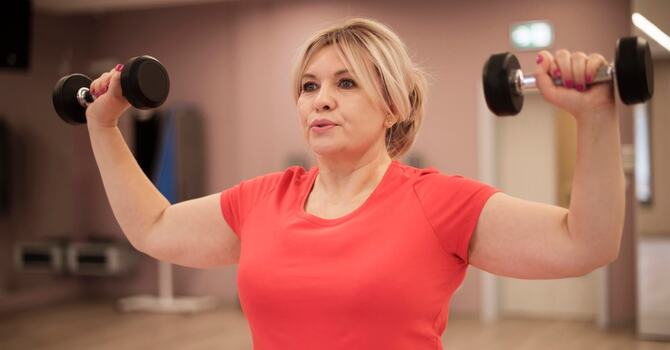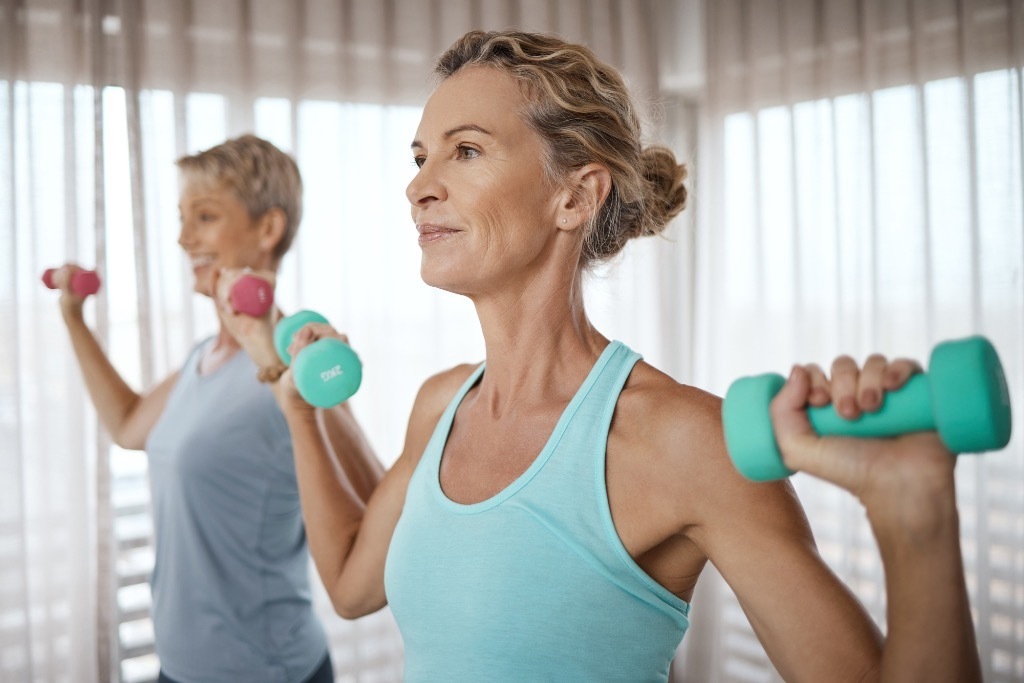
You have been active for years.
Running, lifting, cycling, hiking, taking classes. Whatever your version of staying fit looks like, it has been a consistent part of your life, and your body has always responded to it in a way you understood.
Then something shifted.
The workout you have done a hundred times is leaving you more sore than it used to. Recovery takes longer. Energy feels less reliable. Strength that felt stable has started to feel less predictable. Some mornings you wake up after a session feeling like you did far more than you actually did.
Nothing dramatic happened. No injury. No major change in lifestyle. Just a gradual sense that your body is responding differently to the same inputs.
If that is where you are, this is not a sign that your fitness is failing or that something is fundamentally wrong. It is a sign that your body is going through a significant hormonal transition. That transition has real effects on how exercise feels and how the body recovers from it.
Understanding what is actually happening is the first step toward continuing to train in a way that works.
Why Can Exercise Feel Different During Perimenopause?
Perimenopause is the transition period leading up to menopause, typically beginning in a woman's 40s, though it can start earlier. During this time, the hormones that have regulated much of how the body functions, particularly estrogen and progesterone, begin to fluctuate in ways that are less predictable than before.
These hormonal changes do not affect just reproduction. Estrogen in particular has a broad influence on muscle function, tissue recovery, sleep quality, joint comfort, and how the body manages stress and inflammation. When its levels become less stable, effects can show up in places that seem unrelated to hormones at first. Including how hard a workout feels, how quickly the body recovers, and how consistently energy is available.
It is worth being clear about what this does and does not mean. Not every change in how exercise feels during perimenopause is directly caused by hormonal shifts. Sleep, stress, training load, nutrition, and life circumstances all play a role. But for active women who have not changed anything significant about how they train and are noticing clear differences in how their body is responding, perimenopause is a relevant and often underacknowledged part of the picture.
Common Ways Perimenopause Can Affect Your Workouts
The effects are not the same for every woman, and they do not all appear at once. But these are the patterns that active women most commonly notice during perimenopause.
Recovery takes longer
This is often the first thing women notice. A session that used to need one day of recovery now seems to need two. Muscle soreness is more pronounced after workouts that would not have produced much soreness before. The body still adapts. It just takes more time to do it.
Energy becomes less consistent
Training energy can fluctuate in ways that feel disconnected from sleep or effort levels. Some days feel completely normal. Others feel harder than they should for no obvious reason. This inconsistency is one of the more frustrating aspects of this period because it makes it difficult to know how hard to push on any given day.
Strength and muscle feel different
Maintaining muscle mass requires more deliberate effort during perimenopause than it did earlier in life. Women who are training consistently may notice that results feel slower to come or harder to maintain. This is not a sign that training is not working. It is a sign that the stimulus needed to produce adaptation may need to be more intentional.
Joint and muscle comfort changes
Some women notice increased stiffness, aches, or joint discomfort during this period, particularly in the knees, hips, and shoulders. This is not universal, but it is common enough that it warrants attention rather than being dismissed as general aging.
Sleep affects everything
Sleep disruption is one of the most widely reported experiences during perimenopause, and its effect on exercise is direct. The body does its recovery and adaptation work during sleep. When sleep is fragmented or insufficient, training tolerance decreases, soreness increases, and the gap between effort and result widens. Poor sleep is often doing more work than training load in explaining why exercise suddenly feels harder.
Does This Mean You Need to Stop Exercising?
No. And this point is worth being direct about.
Changes in how the body responds to exercise during perimenopause are not a signal to pull back from activity. In most cases, they are a signal to be more thoughtful about how activity is structured.
Exercise remains genuinely valuable during this period. Strength training in particular supports the maintenance of muscle mass and bone density, both of which become increasingly relevant during perimenopause. Cardiovascular activity supports heart health, mood, and energy. Movement in general supports sleep, stress management, and the ability to stay physically capable in the ways that matter most day to day.
What may need to change is not whether you exercise, but how training load, recovery, and progression are managed. A session that once required minimal recovery may now warrant more. A week where sleep has been disrupted may call for less intensity than planned. Progress may be more gradual than it was at 35. None of that is failure. It is adaptation.
The women who tend to stay most active and capable through perimenopause and beyond are the ones who adjust their approach when the body signals that something needs to shift, rather than either pushing through everything regardless, or stepping back from activity entirely.

How to Adjust Your Training During Perimenopause
There is no single perimenopause training protocol that applies to every woman. Training history, current fitness, sleep, stress, pain history, and goals all shape what the right approach looks like for any individual. With that said, a few principles tend to apply broadly.
Prioritizing strength training is generally valuable during this period, even for women whose primary activity is running, cycling, or another form of cardio. Maintaining muscle mass and joint resilience becomes more important, not less, as hormonal changes affect how easily those things are maintained.
Consistency tends to produce better results than intensity. Regular training across weeks and months builds more durable capacity than sporadic high-effort sessions followed by extended recovery. If energy or recovery is variable, maintaining the rhythm of training, even at reduced intensity on harder days, is more valuable than skipping sessions to wait for conditions to feel right.
Recovery deserves more deliberate attention than it may have received before. Sleep, adequate nutrition, and managing overall stress load are not separate from training. They are part of what determines how well the body adapts to it.
Adjusting training when the body signals a need to is not a setback. It is good practice. A week of reduced load when recovery is lagging, or modifying an exercise that is causing persistent discomfort, is smarter programming than pushing through and paying for it later.
Finally, continuing the activities that are meaningful is important. Running, golfing, hiking, lifting, taking classes. These things have value beyond fitness metrics. Perimenopause may require some adjustments to how those activities are approached, but it rarely requires abandoning them.
When Exercise Changes May Be More Than a Training Issue
Not every change in how exercise feels during perimenopause is simply a matter of adjusting training load or recovery. Some symptoms deserve evaluation rather than self-management.
It is worth speaking with a healthcare provider or movement specialist when:
- exercise-related changes include persistent or worsening pain that does not settle between sessions
- a significant and unexplained drop in exercise tolerance
- an injury that is not improving with rest and modified training
- symptoms that are meaningfully interfering with normal daily activity.
Pain that shows up consistently during certain movements, gradually worsens, or starts changing how you move is not something to train around indefinitely. It is information about something specific that is worth understanding properly.
At Strive2Move, we work with active women who are navigating exactly this kind of uncertainty. When the question is not just "why does exercise feel different" but "why does this specific thing keep hurting when I train," a movement assessment gives a clearer picture than waiting to see whether things settle on their own.
Staying Active Through Perimenopause
Perimenopause changes how the body responds to exercise. It does not change the value of staying active.
The women who move through this period with the most confidence in their body are generally not the ones who found a perfect protocol. They are the ones who stayed curious about what their body was telling them, made adjustments when something stopped working, and did not interpret those adjustments as evidence that their active years were behind them.
Your fitness history is an asset during this period, not a liability. The body you have trained is more resilient than one that has not been. What it may need now is a slightly different conversation. One that accounts for where you are rather than assuming the rules from a decade ago still apply in exactly the same way.
Staying active through perimenopause is not about maintaining everything exactly as it was. It is about continuing to do the things that matter to you, with an approach that actually fits where your body is right now.
If exercise has started feeling different and you are not sure whether it is a training issue, a movement issue, or something worth having assessed, a free discovery visit at Strive2Move in Martinsville, NJ is the best place to start.
Strive2Move | 1910 Washington Valley Rd, Suite 4, Martinsville, NJ 08836 | (908) 547-0729